
On our Africa gateway to Lake Kivu in Rwanda, we spent 4 days and 3nights at Serena Lodge Lake Kivu Rwanda. It is 2 kms from Congo border and near 12 000 strong refugee camp
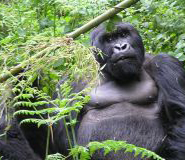
But the main attraction of course was the gorilla tracking. We were lucky to meet with the tribe within 90 minutes of medium stride walking.
What an experience to be among them for 1 hour. But you need to really do it twice! Permits are not cheap $750 a time but since you have to travel so far, 4 hr flight from Jhb to Kigali and 4 hr drive time to Lake Kivu. Highly recommended! “It is the pearl of Rwanda”
Lake Kivu is a beautiful lake, especially in the southern strip around Kibuye. Recommended for a few days of sunshine and relaxation, nice drives and to simply leave behind the city.
Lake Kivu is one of the African Great Lakes. It lies on the border between the Democratic Republic of the Congo and Rwanda, and is in the Albertine Rift, the western branch of the East African Rift. Lake Kivu empties into the Rusizi River, which flows southwards into Lake Tanganyika. The name comes from Kivu which means “lake” in Bantu language, just like the words Tanganyika or Nyanza.
The Lake covers a total surface area of some 2,700 km2 (1,040 sq mi) and stands at a height of 1,460 metres (4,790 ft) above sea level. Some 1 370 km2 or 58% of the lake’s waters lie within DRC borders. The lake bed sits upon a rift valley that is slowly being pulled apart, causing volcanic activity in the area, and making it particularly deep: its maximum depth of 480 m (1,575 ft) is ranked eighteenth in the world.
The world’s tenth-largest inland island, Idjwi, lies in Lake Kivu, as does the tiny island of Tshegera, which also lies within the boundaries of Virunga National Park; while settlements on its shore include Bukavu, Kabare, Kalehe, Sake and Goma in Congo and Gisenyi, Kibuye and Cyangugu in Rwanda.
Native fish include species of Barbus, Clarias, and Haplochromis, as well as Nile Tilapia. Limnothrissa miodon, one of two species known as the Tanganyika sardine, was introduced in 1959 and formed the basis of a new pelagic zone fishery. In the early 1990s, the number of fishers on the lake was 6,563, of which 3,027 were associated with the pelagic fishery and 3,536 with the traditional fishery. Widespread armed conflict in the surrounding region from the mid-1990s resulted in a decline in the fisheries harvest.
I would also recommend driving from Gisenyi to Kibuye, it is an offload track, part of the Nile Trail and the scenery is magnificent. I think it is the best way to see the rural Rwanda.
There is no need to go to fancy hotels; there are plenty of small guest houses run by locals, especially in Gisenyi.


